
Ballistic vest vs. ballistic shield
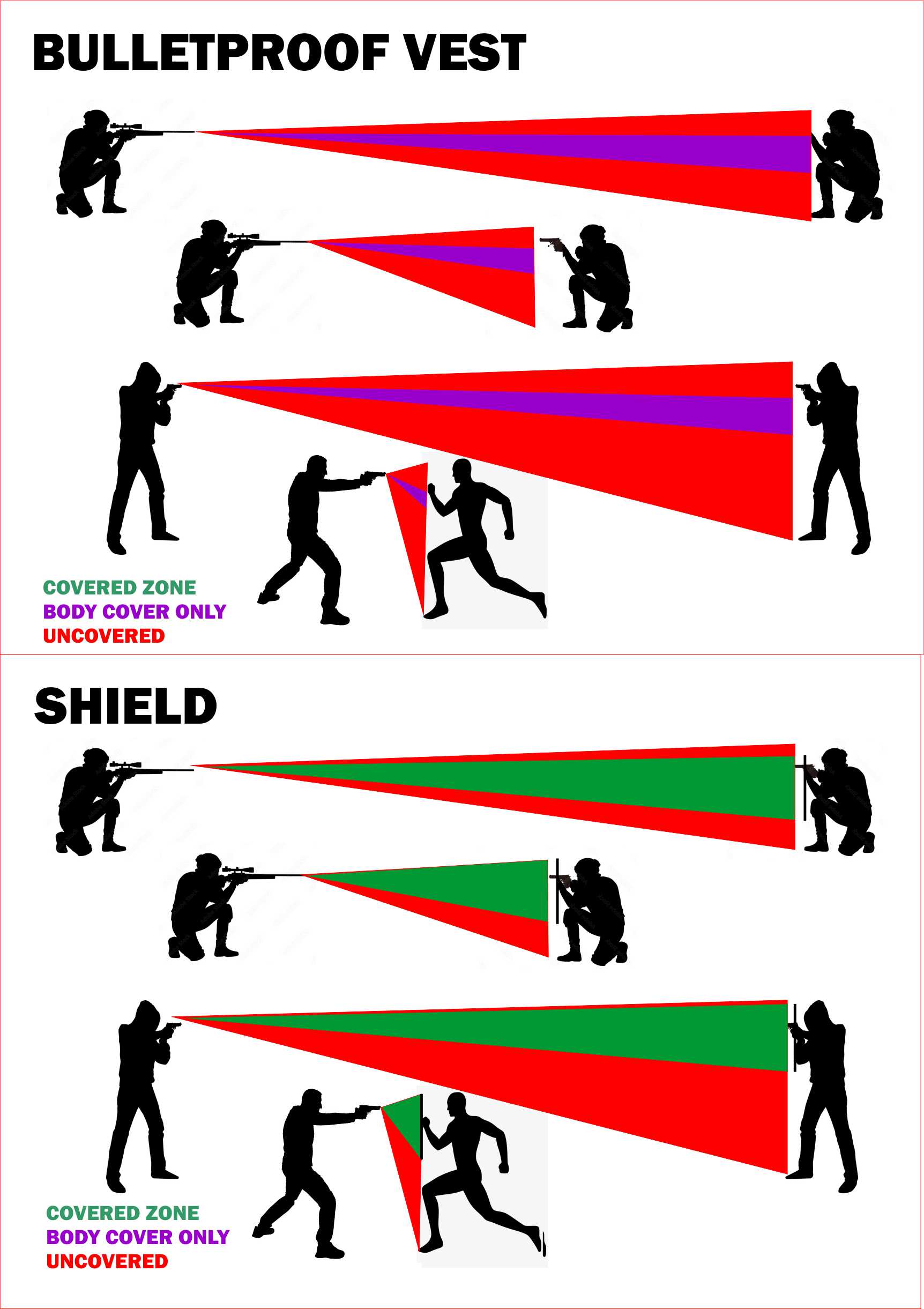
Real protection comparison
„Bulletproof vest vs. ballistic shield?
It is not a return to the past, but a response to real situations in which incidents are taking place today - often quickly, unpredictably and without preparation.
Passive vs. active protection
The ballistic vest is passive protection - protects only the fixed centre of the body.
The ballistic shield is active protection - protects the body and hands and allows you to control what is covered and where the threat comes from.
👉 The vest protects the body.
👉 The shield protects the space between man and threat.
Coverage in a real situation
The vest primarily covers the torso and its effectiveness is highest when hit in a perpendicular direction.
The shield, on the other hand:
- covers a larger area of the body, including the limbs,
- allows you to react to the direction of fire,
- when squatting or lying down, it can also provide complete coverage.
An attacker thus seeks a significantly smaller vulnerable area against a shield than against a person protected by a vest.
Immediate usability
In a crisis situation, seconds make the difference.
The vest must be put on in advance.
The shield can be:
- grasp and use immediately,
- have it ready in the vehicle or at the workplace,
- to be used even in a sudden attack without preparation.
This makes it an essential element of protection in real operation.
Variability and tactics
The shield can be actively tilted and adapted to the situation:
- covering the head, torso and limbs,
- use in motion, kneeling and lying down,
- combination with surrounding cover (vehicle, wall, obstacles).
The vest allows no such thing - its protection is fixed.
Resistance and behaviour in case of intervention
Composite vests:
- they transfer some of the energy into the body,
- can cause injuries, trauma shock (e.g. rib fractures),
- degrade with repeated hits,
- protection is lower in the regions.
Steel ballistic shield:
- decomposes and deflects energy,
- resists repeated hits,
- hitting the shield does not transmit a paralyzing effect to the protected person (see 7.62×39 tests),
- retains its function even in the peripheral parts.
Tactical advantage
In a clash, the shield holder has a major advantage:
- The attacker is aiming for a small exposed target,
- The defender is aiming for a standard mid kick.
The result is a significant asymmetry in favour of the protected person.
Other types of threats
The shield also provides protection outside of shooting:
- against fragments and explosions,
- against small drones,
- against knife and stab attacks (acts as a physical barrier).
The vest is limited in these scenarios.
Use in a civilian environment
A major benefit of the shield is shown by civilians and institutions:
- reception, concierge, security,
- schools and public buildings,
- administrative premises.
In these situations:
- the vest is not normally worn,
- there's no time to put it on.
The shield, on the other hand:
- is available immediately,
- allows you to get cover in seconds,
- gives you the opportunity to retreat, escape and call for help.
At close range, it also acts as an effective barrier against knife or physical attack.
In security training, it can also be used to actively defend and displace an attacker.
👉 Key advantage:
no need to wear it - just keep it handy
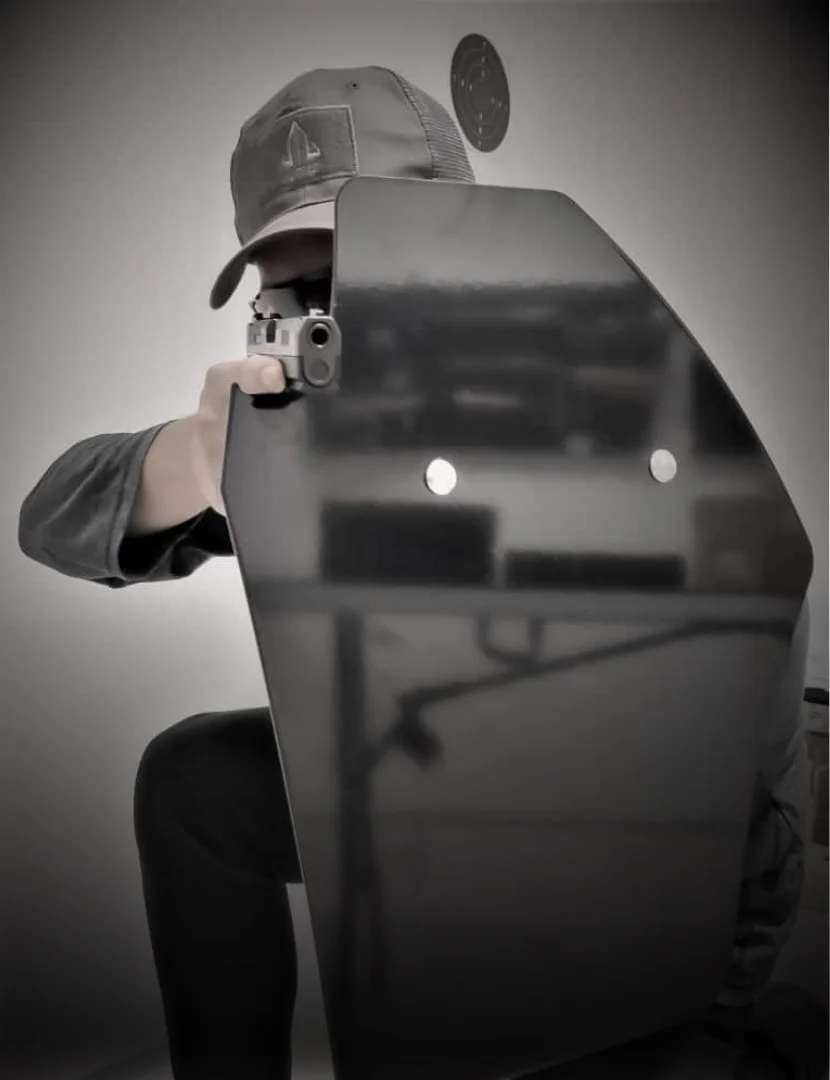
Where the vest has an advantage
The ballistic vest still has its place:
- protects from behind,
- does not restrict the use of long guns,
- is suitable for permanent wear.
It is not a replacement, but an alternative for the police and a supplement for the army.
Conclusion
The ballistic shield represents the return of a simple principle - to separate people from the threat with a physical barrier.
In a modern context, it offers:
- immediate cover,
- a larger protective area,
- greater tactical flexibility.
It is a means that in many situations provides a significantly higher chance of survival.
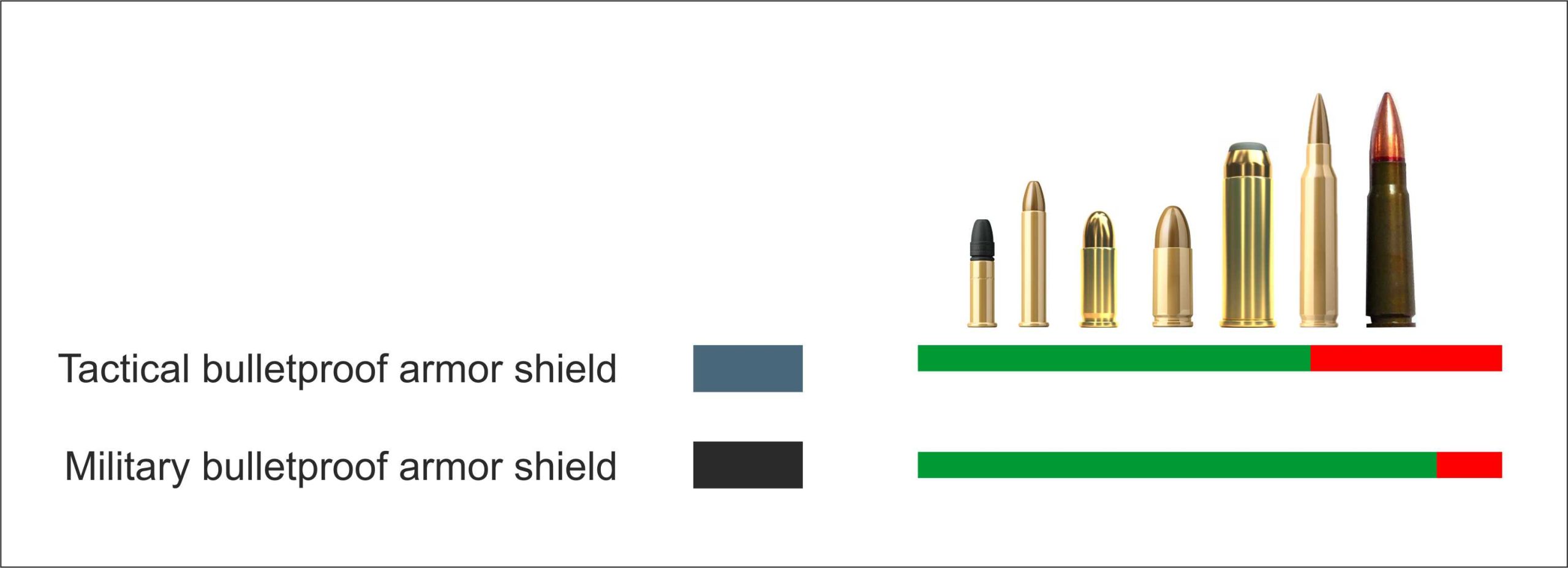
IQ160.eu shields are available in two versions, Tactical and Military
Tactical option:
≈ NIJ IIIA / VPAM 3-5 (common short guns)
Military variant:
≈ NIJ III-IV / VPAM 6-9 (Rifle threats, including 7.62×39 or 5.56 NATO - effectiveness may be reduced for steel-core rounds)
Each product comes with a sample of material for self-testing.